

September 29, 2026
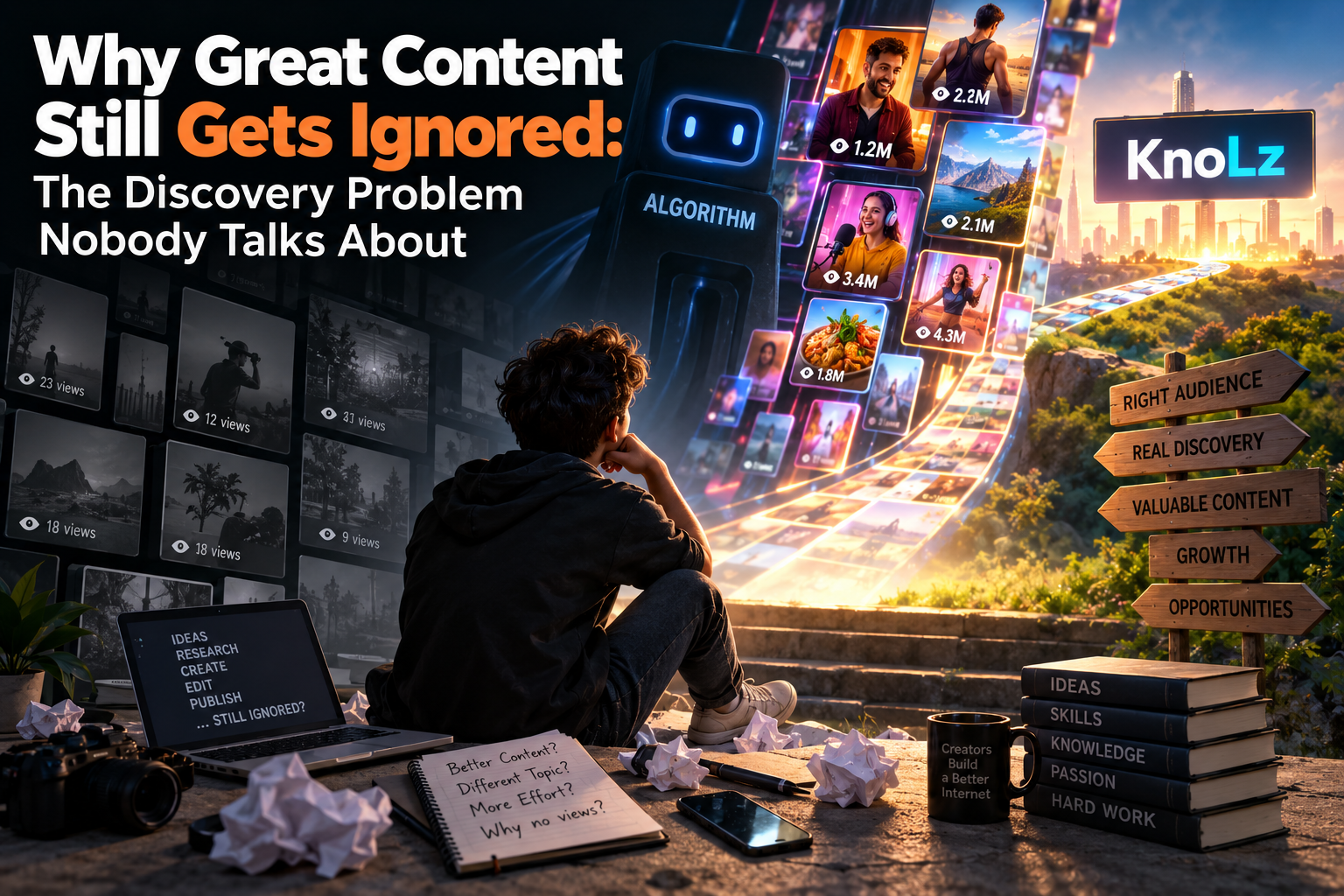
Why Great Content Still Gets Ignored: The Discovery Problem Nobody Talks About
Every day, millions of videos, posts, articles, podcasts, images, and ideas are published online.
Some are average.
Some are excellent.
And many of the excellent ones are never discovered.
That is the uncomfortable reality of today’s creator economy.
We often hear that “good content always wins.” But in practice, good content is only one part of the equation. A creator can spend hours researching, recording, editing, designing, and publishing something genuinely valuable and still receive almost no attention.
The problem is not always content quality.
Sometimes, the real problem is discovery.
The Internet Has More Content Than Attention
There was a time when simply publishing regularly gave creators a reasonable chance of being discovered.
That world has changed.
Today, every creator is competing with:
Established influencers
Media companies
Brands with dedicated content teams
AI-generated content
Short-form entertainment
News and trending topics
Creators who already have millions of followers
The amount of content being produced is growing much faster than the amount of human attention available.
That creates a fundamental imbalance.
There is almost unlimited content.
But every person still has only 24 hours in a day.
Platforms therefore have to decide what gets shown and what gets ignored.
And that decision can determine whether a creator reaches one hundred people or one million.
The Cold Start Problem
Imagine two creators upload equally useful videos.
The first creator already has 500,000 followers.
The second creator has 23 followers.
Even if the second creator produces better content, the first creator usually has several natural advantages.
Existing followers generate early views.
Those views generate likes, comments, watch time, and shares.
Those engagement signals may encourage the platform to distribute the content further.
The smaller creator begins with almost none of those signals.
This is sometimes described as a cold start problem.
New creators are effectively asking an algorithm:
“Please trust my content before enough people have interacted with it.”
But algorithms often depend on interaction signals to decide whether content deserves wider distribution.
That creates a difficult loop.
You need visibility to generate engagement.
But you often need engagement to earn visibility.
Talent and Distribution Are Different Skills
One of the biggest misconceptions in the creator economy is that the person who creates the best content will automatically build the biggest audience.
Creating great content and distributing great content are completely different skills.
A brilliant teacher may not understand thumbnails.
A talented filmmaker may not understand SEO.
A knowledgeable entrepreneur may not know how to write hooks.
A musician may create an incredible track but have no audience to launch it to.
Meanwhile, another creator may understand packaging, timing, trends, retention, and distribution extremely well.
That person may grow much faster even if the underlying content is not dramatically better.
This does not mean platforms are intentionally unfair.
It means modern creators have to solve two problems simultaneously:
Create something valuable.
And then:
Get the right people to discover it.
Algorithms Cannot Understand Everything Instantly
Recommendation systems are incredibly sophisticated, but they are not mind readers.
When a new piece of content appears, a platform has limited information.
It may analyze signals such as:
Topic
Caption
Keywords
Watch time
Click-through rate
Likes
Comments
Shares
Saves
Viewer behaviour
Previous creator performance
Audience interests
But many of the strongest signals only become available after people start interacting with the content.
This means early distribution can matter enormously.
If content reaches the wrong audience first, people may ignore it.
The system may interpret that lack of engagement as weak content.
But the content itself might not be weak.
It may simply have reached people who were never interested in that subject.
Discovery is therefore not only about how many people see something.
It is also about which people see it.
Established Creators Have Compounding Advantages
Audience growth has a compounding effect.
A creator with an established audience benefits from previous work every time something new is published.
Subscribers receive notifications.
Followers recognize the creator.
Existing viewers trust the content.
Previous videos continue generating traffic.
Search engines already understand the creator’s authority.
Other creators may share or reference their work.
Brands may amplify their content.
Every successful piece of content strengthens the next one.
New creators usually start without this ecosystem.
They are not simply competing against another video.
They are competing against years of accumulated audience, trust, data, and distribution.
That makes breaking through difficult, even when the content deserves attention.
The First Few Seconds Have Become Extremely Important
Content discovery has also changed because people scroll faster than ever.
Before someone decides whether your content is useful, they may judge it in seconds.
Sometimes less than a second.
A creator therefore has to answer several questions almost instantly:
Why should someone stop scrolling?
Why should they click?
Why should they continue watching?
Why should they trust this creator?
Why should they come back?
This is why titles, thumbnails, opening lines, visual presentation, editing, and storytelling have become so important.
The quality of the information may determine whether someone loves the content.
But packaging often determines whether they discover it at all.
Smaller Creators Often Have Something Big Platforms Need
Interestingly, smaller creators frequently have an advantage that large creators struggle to maintain.
They are closer to niche communities.
They understand specific problems.
They experiment faster.
They can build deeper conversations with early followers.
They often create highly specialized knowledge that would never appear in mainstream media.
A mechanic explaining a rare engine problem.
A designer sharing a specific workflow.
A local entrepreneur explaining a regional business challenge.
A teacher simplifying a difficult concept.
A developer solving an obscure technical bug.
The internet contains enormous amounts of valuable knowledge like this.
The challenge is connecting that knowledge with the people who actually need it.
Discovery Should Become Smarter, Not Simply Bigger
Most creators do not necessarily need millions of views.
They need the right audience.
A business creator may benefit more from 2,000 relevant viewers than 200,000 random views.
A technical writer may only need a small community of highly engaged professionals.
A local creator may care more about people in one city than viewers across the world.
This suggests that the future of content discovery may not simply be about maximizing reach.
It may be about improving relevance.
Instead of asking:
“How can this content reach everyone?”
A better question may be:
“Who is most likely to genuinely value this content?”
That shift could create healthier opportunities for both creators and audiences.
Search and Recommendation Are Moving Closer Together
People no longer use social platforms only for entertainment.
They increasingly use them to discover:
Products.
Skills.
Opinions.
Tutorials.
Businesses.
Places.
News.
Ideas.
Communities.
This means the boundary between a social network, recommendation engine, and search engine is becoming less clear.
The next generation of content platforms may need to understand not only what is popular, but also what people are actively trying to learn or discover.
That creates an opportunity for more intent-driven discovery.
Instead of popularity being the strongest signal, relevance could become more important.
What KnoLz Is Thinking About
KnoLz is being built around a simple question:
Can useful content get a better opportunity to be discovered?
The goal is not to promise instant virality.
No serious platform can guarantee that every creator will become popular.
The bigger idea is to rethink how knowledge, creators, communities, and discovery can connect.
A platform should help people find content because it is relevant to them, not only because millions of people have already watched it.
For creators, this could mean a better opportunity to reach people genuinely interested in their subject.
For users, it could mean discovering useful voices before they become famous.
And for the internet as a whole, it could mean that valuable ideas have a better chance of being seen.
The Creator Economy Is Still Early
It may feel like social media is already mature.
In reality, online creation is still evolving rapidly.
AI is reducing production costs.
Anyone can create professional-looking images.
Voice generation is improving.
Video production is becoming faster.
Translation is making content global.
Small teams can now produce what once required entire studios.
That means content creation will continue growing.
And when content becomes easier to create, discovery becomes even more important.
The future problem may not be:
“How do we create more content?”
It may be:
“How do we find the content that actually matters to us?”
That is a much bigger challenge.
And perhaps one of the most important opportunities in the next generation of the internet.
SEO Title: Why Great Content Still Gets Ignored: Understanding the Creator Discovery Problem
URL Slug: why-great-content-gets-ignored
Meta Description: Great content does not always get discovered. Explore why new creators struggle with visibility, how algorithms shape reach, and why smarter content discovery could define the future of the creator economy.
19